Lisa’s Last Dance

Author’s Note: I’ve always thought dancers are just about the most athletic in terms of strength and conditioning. There are those that excel, those that get by, and those who will never realize their potential, through no fault of their own. This story is for them, because they still dance in their memories, their imaginations, and their hearts. They are still, to my mind, dancers…

In the halls of her school, Lisa heard the comments.
“Such a promising career ahead…”
“Never dance again…”
“…a tragedy…” “…a shame…”
“Never walk again …” “…dancing is finished…”

Her face would heat, and she’d roll the chair a little faster, enduring the day, the comments sown like bitter seeds in her heart. Time was against her; her muscles hadn’t atrophied yet, but they were on the way.

She sighed, but today, she managed not to cry.

***********************
Her father rolled her like a cargo of five gallon drums into the back of the van after school, and took her home.
She did her homework before dinner since there wasn’t much.
Her parents were watching television when she rolled the chair in front of them.
“Lisa? What is it, honey?” her mother said.
“Take me there.”
“Honey, please. We’ve been over this. The doctors…”
“Yes, I know, Dad. The doctors, it’s always the doctors said…”
“Lisa, be realistic!
No!
She slammed her fists on the arms of her wheelchair, and her parents jumped. She got her breathing under control, kept her eyes averted to blink back the tears that threatened; if she cried now, it would be over.
She looked up at them after a moment, her eyes clear, her gaze steady.
“No. Take me there.”
Huffing in frustration, but without another word, her father clicked off the tv and loaded her into the van. Her mother rode shotgun, and they rode in silence.

**************
The dance class stopped when Lisa came to the door.
“Lisa?”
“Hello, Mrs. Castro.”
“What are you doing here?”
“I came to start over.”
“Lisa, honey, I can’t…”
“We told her, Mrs. Castro,” her mother said. “We told her what the doctors said, but she insisted.”
Mrs. Castro sighed. “Let her come to grips with it. It’s the only way they’ll stop sometimes. I’ve seen it before.”
Lisa rolled the chair past Mrs. Castro.
***************************
The other girls watched in stunned silence.
Stopping before the mirror, Lisa took a good long look at herself, taking stock of what she was about to do, and whether or not it was worth it.
And she turned the chair sideways, placed her feet on the floor and placed her hands on the barre, her breathing deep.
The other girls watched at first, as her arms began to shake, her knuckles tighten and slip; she wiped her hands on her useless knees, and got another grip, and pulled again.
And little by bit, Lisa began to pull herself up, trembling, shaking, but slowly rising.
“Lisa, don’t do this,” her mother said, her hands over her chest.
“Lisa, stop!” her father said.

**********************
She bit her lip as the tears stung again, and one escaped, and she rose a little higher.
With her next pull, she gave a small cry of pain, and one of the girls broke from the circle and got behind her, and put her arm around Lisa’s middle, supporting her, her knees and thighs aligned with Lisa’s own, which were almost like a marionette’s, but there was still something there, and she pushed the chair a little distance away.
Lisa went higher, her breath hissing between her teeth. The girl behind her was straining with the weight, and she didn’t want to fall backward.
Another one joined her, and stooped to put Lisa’s hands on her shoulders as she supported Lisa’s arms.
Lisa went higher, even as the pain ripped through her and she cried out again.
Two more joined and supported the two girls who were holding Lisa.
She went up a little more.
And another came, and another, and then the rest, reforming the semi-circle that had been around Mrs. Castro, and they began to call out.
Do it, Lisa!”
“Come on, girl!”
“Kick, Lisa! Higher!”
“You call that a pirouette?”
“If you can’t hack it, pack it!”
“Get that leg up!”
“Balance, keep your balance!”
“Spin faster, stupid!” They all laughed a little louder at that, and Lisa strained with the effort.
And kept rising.

**************************
The girls began to cry through their smiles as Lisa struggled, inch by inch, her own cries lost in their laughter and shouts and cheers of tough love that sounded like reprimands they’d all heard and said, standing together back then as vulnerable and fearful children, standing together now as vulnerable, fearful young women with confidence and hope.
And today, centered on their broken, fallen angel, they anointed her with all they had, and it filled the studio like morning vespers.
And when Lisa finally stood, leaning on their arms and shoulders, wracking, drenched, and beautifully terrible, still shaking, crying and trembling as they embraced each other in bittersweet victory, it was for different reasons.
Wish I Could Go Back Knowing What I Know Now

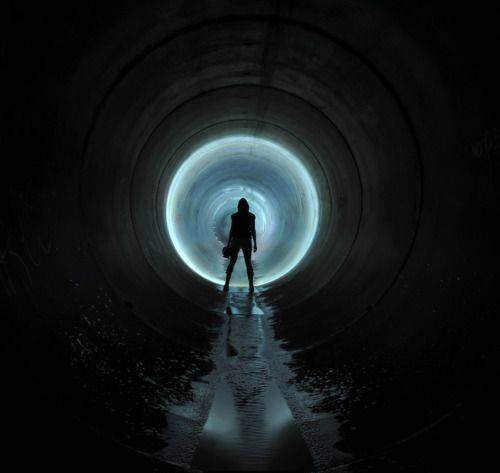
   Deep in the abandoned culvert, the portal appeared.

   Walking along the waterfront, I thought I heard kids playing inside the drain pipe.

   Stupid kids. Wish I could go back sometimes, knowing what I know now.

   I huffed my way down to  get them out of harm’s way.

   There was light where there shouldn’t have been.

    At the other end, I saw myself.

                                                   *******************

   Kid -me surrounded by friends, looking every bit the kid that got bullied. Skinny and awkward the way child nerds are,nowhere close to any slang that would describe him as cool. But he and his friends were happy. 

    About to make a wish, he saw me, and shook his head. 

   I wasn’t invited.

                                                   *********************

 Teenage-me walking down Broadway with my poet friend, the city streets energized in the warm evening, full of bright colors, short skirts, and festive noises, and a busking sax player trying to tear a hole in the sky. 

  We were on our way to my first poetry reading at the cafe.  I was nervous but excited.

  Teenage-me stopped talking to his friend when he saw me, and shook his head.

   I wasn’t welcome.


                                                   *******************

    A quiet Sunday afternoon in the hospital, grad-me stood beside the bed where his wife trembled from the c-section shots. The doctor handed the bundle to him.

   His newborn daughter looked at him, as quiet as the day, and melted his heart.

   ‘She’s beautiful.’ he told his wife, and let her see.

   Then grad-me saw me,standing at the end of the portal, and shook his head. 

   I wasn’t part of the family.


                                                   ******************


   The light faded, leaving me in darkness. 

    I walked back and started home, wiping tears.

    They weren’t invited, allowed to fall, or part of the family anymore.

    I never made that wish again.


The Day I was Handy

My relationship with tools can best be described as ambivalent.

I wasn’t afraid of them, but whenever they had to be used, they produced in me a sense of dread because it meant that something had to be repaired or assembled, and there was always the lingering question: Will I have parts left out when I’m done? Because that meant an improper assembly or repair, and I’d have to do it all over again.

My father was handy, and could pretty much fix anything; he handled tools with a craftsman’s concentration and confidence. He didn’t live with us, but when my mother wanted something done to our apartment and he could do it, he would.

I watched him painstakingly match wallpaper and tile so the patterns weren’t broken.

I watched him glue, wire, carve wood, spackle, grout, paint, and garden (at his place) with alacrity. I had no such confidence in my own skills to even remotely approach the quality of his work.

And then I became a Dad, and then we rented a house with a sizable yard that I was now responsible for as a man whose idea of nature was visiting Central Park and the Bronx Zoo.

Cribs, bikes, dollhouses, power outages, plumbing and car problems when there was no money to pay the tradesmen took care of those things all combined to come at me in a variety of configurations.

And so began the accumulation of hardware, of knowledge that demanded dexterity (if not speed), caution, and in time, more confidence than not. (No pieces left over! Yes!)

Those days are past me now, and the presence of my father is no longer on the earth, but the dust, dirt, and rust on my own toolbox has been hard won.

My ambivalence remains because, as I said before, it means something has gone wrong ( Aw man, a problem…)  and needs immediate attention, but I think of what my father would do, and how his legacy of excellence guides my hands. (Problem solved!)

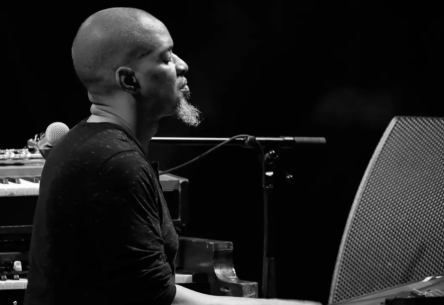
Listen…(for Kofi B.)

I last saw cousin Kofi six years ago in Allentown, PA. at the Miller Symphony Center.  I’d heard that TTB was in town.

They’re an exciting, dynamic band that can play anything, and Kofi, being a co-founder and extraordinary composer and musician on keys and flute, helped to increase their library of quality music in their already impressive repertoire.

I went to see the performance, and it was stellar, as always.

After it was over, Kofi did his thing with the fans, and when that passed we went into the tour bus. He offered me half of his Cuban sandwich, and we talked about the show, the music, his performance in particular, and life in general.

When the bus had to get parked, we went to his hotel room, and he saw my brief three seconds of internet presence on a performance I was part of in Easton, PA for a Christmas special.

After he saw it, he beamed and said to me, “You’ve come a long way.”

Coming from him, it was more than validation.

Through the years, we saw each other sporadically, but whenever I was in DC we’d share some time in my uncle’s ‘music room,’ a space that ran wall to wall with vinyl from every genre, too extensive to ever go through in one sitting, and even more massive than my Dad’s.

During the summer of ’78, I spent long hours in that room, and spent some time with Kofi in there as well as we listened to music he’d written, music he was working on, and music he liked. It was my introduction to jazz fusion in particular, and he revealed to me his love of electronic music and its potential to break new ground.

I explored some jazz history on my own, never dreaming one day I’d get to see him play alongside some names that I was listening to at the time. What an even bigger kick it must have been for him.

Kofi once told me back then that a true musician ‘listens to everything.’ At first, I thought he meant different types of  music, but he really did mean everything. A car horn, birds, the pitch of voices, pipes hissing. His gift was so open, he was always literally surrounded by music: the music of life itself.

There were times, my aunt told me, that when he was off the road, silence was all he craved, once to the point where she had to take down her wind chimes. I understood that. The anointed need to have their own space of silence sometimes.

I would’ve liked to have seen him once again, and more than that, to play on the family  project that was a dream of his, but unfortunately it never gelled together.

It would have been glorious, but I understand that too; his workload was as massive as his gift.

The music that he left behind is extensive, and has touched the lives of many.

The music that he hears now is just for him alone.

I know he’s enjoying it.

I can see him now, eyes closed, little tics of expression and appreciation flitting across his features, and I know exactly what he’d say if I were sitting beside him:

Listen…