Lisa’s Last Dance

Author’s Note: I’ve always thought dancers are just about the most athletic in terms of strength and conditioning. There are those that excel, those that get by, and those who will never realize their potential, through no fault of their own. This story is for them, because they still dance in their memories, their imaginations, and their hearts. They are still, to my mind, dancers…

In the halls of her school, Lisa heard the comments.
“Such a promising career ahead…”
“Never dance again…”
“…a tragedy…” “…a shame…”
“Never walk again …” “…dancing is finished…”

Her face would heat, and she’d roll the chair a little faster, enduring the day, the comments sown like bitter seeds in her heart. Time was against her; her muscles hadn’t atrophied yet, but they were on the way.

She sighed, but today, she managed not to cry.

***********************
Her father rolled her like a cargo of five gallon drums into the back of the van after school, and took her home.
She did her homework before dinner since there wasn’t much.
Her parents were watching television when she rolled the chair in front of them.
“Lisa? What is it, honey?” her mother said.
“Take me there.”
“Honey, please. We’ve been over this. The doctors…”
“Yes, I know, Dad. The doctors, it’s always the doctors said…”
“Lisa, be realistic!
No!
She slammed her fists on the arms of her wheelchair, and her parents jumped. She got her breathing under control, kept her eyes averted to blink back the tears that threatened; if she cried now, it would be over.
She looked up at them after a moment, her eyes clear, her gaze steady.
“No. Take me there.”
Huffing in frustration, but without another word, her father clicked off the tv and loaded her into the van. Her mother rode shotgun, and they rode in silence.

**************
The dance class stopped when Lisa came to the door.
“Lisa?”
“Hello, Mrs. Castro.”
“What are you doing here?”
“I came to start over.”
“Lisa, honey, I can’t…”
“We told her, Mrs. Castro,” her mother said. “We told her what the doctors said, but she insisted.”
Mrs. Castro sighed. “Let her come to grips with it. It’s the only way they’ll stop sometimes. I’ve seen it before.”
Lisa rolled the chair past Mrs. Castro.
***************************
The other girls watched in stunned silence.
Stopping before the mirror, Lisa took a good long look at herself, taking stock of what she was about to do, and whether or not it was worth it.
And she turned the chair sideways, placed her feet on the floor and placed her hands on the barre, her breathing deep.
The other girls watched at first, as her arms began to shake, her knuckles tighten and slip; she wiped her hands on her useless knees, and got another grip, and pulled again.
And little by bit, Lisa began to pull herself up, trembling, shaking, but slowly rising.
“Lisa, don’t do this,” her mother said, her hands over her chest.
“Lisa, stop!” her father said.

**********************
She bit her lip as the tears stung again, and one escaped, and she rose a little higher.
With her next pull, she gave a small cry of pain, and one of the girls broke from the circle and got behind her, and put her arm around Lisa’s middle, supporting her, her knees and thighs aligned with Lisa’s own, which were almost like a marionette’s, but there was still something there, and she pushed the chair a little distance away.
Lisa went higher, her breath hissing between her teeth. The girl behind her was straining with the weight, and she didn’t want to fall backward.
Another one joined her, and stooped to put Lisa’s hands on her shoulders as she supported Lisa’s arms.
Lisa went higher, even as the pain ripped through her and she cried out again.
Two more joined and supported the two girls who were holding Lisa.
She went up a little more.
And another came, and another, and then the rest, reforming the semi-circle that had been around Mrs. Castro, and they began to call out.
Do it, Lisa!”
“Come on, girl!”
“Kick, Lisa! Higher!”
“You call that a pirouette?”
“If you can’t hack it, pack it!”
“Get that leg up!”
“Balance, keep your balance!”
“Spin faster, stupid!” They all laughed a little louder at that, and Lisa strained with the effort.
And kept rising.

**************************
The girls began to cry through their smiles as Lisa struggled, inch by inch, her own cries lost in their laughter and shouts and cheers of tough love that sounded like reprimands they’d all heard and said, standing together back then as vulnerable and fearful children, standing together now as vulnerable, fearful young women with confidence and hope.
And today, centered on their broken, fallen angel, they anointed her with all they had, and it filled the studio like morning vespers.
And when Lisa finally stood, leaning on their arms and shoulders, wracking, drenched, and beautifully terrible, still shaking, crying and trembling as they embraced each other in bittersweet victory, it was for different reasons.

A Place for Peace

The bright red of the painted bench seemed an act of rebellion in and of itself.
Since his discharge from the army, the prospects for his postwar success dried up like raisins in a drought. The rooms for rent grew cheaper and seedier, but never free, and a man can only descend so far.
He was down to just carrying his duffel bag, the last of his money, and the end of his rope. Swallowing the bitter pills of the last of his pride, he left the hot, dirty building for the hot, dirty streets.
Didn’t think I’d be sleeping under the stars again so soon.
*************
The city’s citizenry were increasingly uneasy with the rising homeless population.             They were less helpful, more hostile, and there were bullies and worse who thought nothing of preying on them.
Fighting over there had prepared him. Still, he was aware of every nervous tic and twitch that made him look like a shell shocked, restless bum. All too aware of every movement, and every sound.
He saw the bright red bench gleaming like a rising red sun on a green sea; there was no one around, and he decided to take a rest on it. Perhaps even a nap.
I hope the cops don’t roust me; that could end badly.

************

He  searched his duffel bag, rooting around: with his fingers he shoved the medals aside and peered into it. He still had two camouflage jackets, two journals bound with black leather covers, and a knife with a large, wicked looking blade.
He repacked the medals and threw the knife in the manmade lake.  Curious, he opened one of the journals, but it was too dark to read it clearly now.
The park was emptying as people went home to their lights, warmth, and loved ones, but he had nowhere to go.
He went back in the duffel and took out one of the jackets, placed the duffel under his head, and stretched out to sleep. Where his previous training would have had him on edge listening for sounds that meant he was a target of someone hiding in the trees, he felt no sense of danger and vulnerability now.
Sleep took him under its wing.
Through the night, the dreams and nightmares played tag.
He relived it all.

                                                      ************

         The long, hot nights with working girls that gave an artful illusion of love for a few hours in smoky, perfumed places.

        Running across the killing fields, legs pumping on adrenaline as bullets tugged at the extra cloth on his uniform as he fled, the splattering of broken, busted flesh with bones poking through skin at odd angles as the man running next to him was suddenly no longer there, and he couldn’t hear his own screams or his heart hammering in fear.
     The slap and flutter of well worn cards played by small fires, and eating silently in the dark on stormy, starless nights.
     Sleep was as rare as finding an uncut diamond in plain sight, and far more precious.
     Taking stock when the skirmishes were over: the dead, the soon-to-be dead, friends, and some precious few he’d named as brothers.
     The scent of blood, the cacophonous clusters of crows, flies, and vultures.

***************
Something hit his head, jolting him; he’d fallen asleep, slipping off the bench, bumping his head.
He felt light and unburdened somehow.
He knew the dreams had been dark, but couldn’t remember them at all. Everything he recalled seemed innocent, even innocuous.
All the memories of war’s ravages were gone.
How did I get here? What am I doing here?

************
In the morning a jogger found him and called the police.
The EMT’s zipped the body bag closed as the birds began to sing and a rind of orange sun turned the night clouds shades of pink and blue.
The cops went through the duffel, saw the medals.
“All that combat,” one said, “and he gets to go out peacefully in the most quiet place in the park.”
The ME took a look at the bright red bench with an expression that got the cop’s attention, so he looked at the bench too.
“Something wrong, doc?”
“Nothing. Just, it’s not the first time it’s happened at this spot, and a lot of old veterans seem to find their way over here.”
“No kidding. Why do you think that is?”
The M.E. came out of his reverie, looked at the cop and shrugged.
“I don’t know. Guess it’s what you said yourself: it’s the quietest place in the park.”
“Makes it easier to slip away?”
The M.E. looked at the bench again, the red gathering some vibrancy in the growing, paling light, then at the midnight black body bag loaded in the back of the ambulance as the doors closed.
“To be finally at peace? Yeah, that ends all kinds of wars.”

The Writer and The Page

“Good morning, Page,” the Writer greeted the blank field of whiteness awaiting him.

“Ah, good morning, Writer. Come to challenge me again?”

The Writer smiled. “Not challenge, conquer.”

The Page returned the smile, though the Writer couldn’t see it. “A worthy, lofty goal.”

“It’s what writers do.”

“Oh? Tell me, Writer, is it worth the isolation, the distant look in the eyes of the person you’re talking to about what you’re writing, the alienation of family and friends, for the sake of justifying the most mundane of arts?”

“You think writing is mundane?”

“You don’t?”

“If I thought that, why would I do it?”

The Page smirked. “Because writers love to moan about their suffering. Dancers and painters alleviate their pain, or live with it, toting their equipment hither and yon. They don’t go on and on about it. They accept the pain as part of the price, but writers somehow always seem amazed by the cost of their craft.
“But the great ones, those artists who don’t write, embrace it. They are the ones who get remembered, the ones who last through the ages.
“Even musicians struggle with their demons, exorcising themselves through their instruments, but they’re on another level of suffering.”

The Writer found himself intrigued. “How so?”

The Page chuckled like a parent at a silly question from their child.

“When dancers have shows, they rehearse. When painters or sculptors have exhibits, they set about creating work that fill the spaces.
“Musicians? They daily spew their demons out into space, and those who hear and understand their gibbering respond to it. They’re taken along down whatever road  the music leads them, whether to perdition or redemption.

“Musicians are the eternal Pied Pipers of the times, destined to be followed even when they’d rather be alone.
“Only writers get to bemoan how real life plunders their ability to create. They say, ‘Oh well, no writing today then. I shall double my output tomorrow.’ And of course, they don’t.
“Every day they whine about their lives: children, spouses, and other family members who just don’t ‘get it.’ And my personal favorite: the pet who demands time and attention, or the kittens asleep on the keyboard.
“They act as if moving the animal is against the law! They let their creatures have their way over practicing their craft. It’s laughable.”
The Page laughed, and said when it was over, “My point is this: these are days writers don’t get back, but act as if somehow they will.”

“So what do you suggest?”

“Isn’t it obvious? Abandon this art, take up a trade and make yourself useful. Leave the writing to those already published. You are too undisciplined, lazy, and unfocused to make this work.”

“But my English teachers all said–”

“They were wrong. They deceived you.”

The Writer sat back, catching his breath, staring at the Page, who stared back, serene, but not smug, at least not outwardly so. The Writer honestly couldn’t figure out if it really believed what it said, or was just baiting him.

He suspected the latter, but he couldn’t let it go yet. “All of them?”

The Page stayed silent, content to let the seed of doubt sink in and hit home.

The Writer poured a shot of whiskey and took it with him, getting up to look out the window.

There were lives out there. Every one unique, going to destinations and fates unknown.
His book would be a droplet in the sea, in a world where there were better disciplined, laser focused, faster writers than himself.

Maybe his teachers were wrong. Had they smiled at him and lied? ‘That one may smile, and smile, and be a villain?’
His girlfriend said she always thought he should write, but did nothing to encourage it or support him. She read the occasional snippet, and praised it, but nothing more.

The whiskey burned his throat, and his flesh heated as the alcohol suffused into his bloodstream.

He held up the glass. How many of his kind had succumbed to this weakness. Or was it a weakness? Maybe not.Did the page back then, like this one, drive the writer to defeat as they drowned themselves and their talent, shot by shot?

He went to sit back down, staring again at the white silence before him, a white silence awaiting his words, subject to his imagination, unwilling to do his ready will.

The Page’s laughter was low, deep, reverberating as if they were together in a cave, and the Writer couldn’t see it standing in the shadows, drawing its knife.

Leave me, writer. I grow weary of your presence.

The Writer drained the glass, and put it back in his desk drawer.

Don’t you want another…?
The Writer didn’t answer, flexed his wrists and fingers over the keyboard.

You have nothing. You’re fooling yourself. It’s undignified, and beneath you. Stop it, ‘writer.’ Stop it, now.

The Writer sighed, and began to type: I am a Writer, and Page is my servant. A defiant, exasperating fool of a servant, but mine nonetheless…

Liberty’s Roommate

His hospital room had a view of the Statue of Liberty.

It seemed like a twisted sort of joke, since he was bound and wired to gadgets that kept track of his vital signs, and the symbol of freedom stood there in the harbor, a deaf and blind sentinel with a false promise in her mute mouth, holding a long extinguished torch.

His nurse, Jeanette, was pretty, though, so that was something. Young, efficient, professional, eyes bright with hope.

He hoped once. Hell, he even saw the Bright Path to Promise back then, but somehow took a detour and ended up on the Dirt Road of Busted Dreams, telling himself that it wasn’t his fault, the lie dying like a gunshot victim before he spoke it.
It didn’t matter now, did it?

He was still where he was, and had to start over again, again.

It was getting to him, all this starting over.

As much as he still thought of himself as young, his eyes, knees, and nether region told him he was way beyond that now. He was slowly accepting it, but felt no obligation to do it gracefully.

People called him ‘sir’ and ‘mister’ now when he was perfectly fine being called by his name, and gave him senior discounts he didn’t ask for.

He took another look out the window to see the sun going down.
Ha! In more ways than one.
“Don’t be maudlin…” he muttered.
“Did you say something, Mister Locke?” Jeanette had come in, and he never heard her open the door.
“No. No, Jeanette, I didn’t.”
She puttered around and checked his vitals. “You okay?”
“I’m in a hospital. Does that make me okay?”
“I’m sorry, sir. I didn’t mean–”
He waved her off. “That’s fine. I know, I’m sorry. I’m just tired…”
“I understand.”
No, my young bright, sweet, hopeful girl,  you don’t. You can’t. Not really, and not for a long time. Hopefully, if you play your cards right, you never will.

She finished, flashed him a bright smile. “See ya later.”

“All right.”

The light from the setting sun caught the metalwork of Liberty’s torch flame, reflecting flares that looked like pennants, as if to let him know her presence in the harbor was no joke, and not to be taken lightly.

He shrugged, turned away from the window, and shuffled back to the bed, clicking the remote for the tv, a hollow laugh track filling the silence, chasing the dark thoughts with empty ones.

Freedom, huh?  

He’d enjoy it, he guessed, however limited, in the time that remained.
For now.

No Victory

The soft shuffling of slippers on tile meant she was already up.

The faintest hue of a pink blush began to brush the sky.

Why so early?

I watch her, but don’t speak.

She runs her hand over her face as she walks toward the door, but she doesn’t turn around to see if I’m awake. I wonder if I would’ve closed my eyes again if she did.

The distances and silences were becoming longer, and more frequent, and attempts to begin conversations through small talk fell flat. Attempts to discuss what was going wrong and how to fix it, and whether or not it was something we really wanted to do, lapsed into a different kind of silence.

Love had settled into familiarity and comfort, but the kind of comfort that came from a raggedy, threadbare blanket full of holes. It was long past fulfilling its purpose, but kept around more out of a sense of nostalgia than anything else.

And we’d settled too, like dust on an antique table depreciating in value. Neither of us thought the effort of restoration was worth the price.

******************

The drive to the airport was silent, as if confirming what she was doing was the right thing to do. It didn’t even feel awkward that I was driving her there.

We were in our memories, just not sharing them, because that might lead to thinking we could salvage what remained. There was, if we were to be honest, a mutual sense of relief and excitement at the prospect of a new start.

It was early enough to find parking. I paid and we each carried pieces of her luggage.

“Traveling light, huh?”

“I threw a lot away.”

“Yes, you did.”

She stopped, gave an exasperated sigh. “Don’t start, love. You said you were fine with me going. You helped me pack. Please don’t make this any more difficult.”

“Any more difficult. It didn’t seem difficult at all.”

“That’s not fair.”

“Maybe not, but that doesn’t make it untrue.”

“We can’t stay together. You know this. Why be petulant now?

“If I had been petulant earlier, would it have changed your mind. Be honest with me, with yourself, for once.”

She started walking again, beside me now, her voice quieter. “I honestly don’t know.”

The new silence was awkward. She stopped again, and took my hands in hers.

“How about a break then, instead of a break-up?”

I considered it. “We can try that.”

“Good.” She kissed my cheek. “I don’t know how long I’ll be gone.”

“Or if you’ll be back.” It wasn’t a question, but she said yes.

“All right, then. Don’t ask if I’ll wait.”

A look of surprised hurt flashed on her face. “I wasn’t going to sleep with anyone.”

“You can’t say that with any certainty, since you don’t know how long you’ll be gone, or if you’ll be back. I’m telling you up front, depending on the circumstances, I’m not waiting.”

The silence grew tense again, but neither of us moved.

“Then neither will I.” Her eyes grew wet.

“Wait a minute…”

“I’m going to miss my flight. You’re lashing out, and you’re making me lash out too, at the worst possible time.

“What do you want to do? A break or a breakup?”

“I…I don’t know.”

She sighed, then told me. “That’s not an answer, but it is. Why now?”

“Why do you need to leave?”

“To stop…this. We keep doing this. I have to go…”  She pulled up the handle to her luggage.

I didn’t move.

“Are you going to help me?”

“Help you walk out of my life? No.”

I flagged down a handler and sent him to her, then I started walking back toward the car, wrestling with my thoughts.

Why couldn’t I decide? Why did I even bring her here at all? 

Why is everything so blurry?

I looked back, hoping against hope she’d be running toward me, and all would be forgiven.

But she was gone.

There would be no rom-com ending.

There never is, except in rom-coms.

Love just dies, like the king of Sparta in that other movie: defiant, loud, and brave, but ultimately overwhelmed, ultimately slain, and fondly remembered in glorious defeat.

No victory.


Listen…(for Kofi B.)

I last saw cousin Kofi six years ago in Allentown, PA. at the Miller Symphony Center.  I’d heard that TTB was in town.

They’re an exciting, dynamic band that can play anything, and Kofi, being a co-founder and extraordinary composer and musician on keys and flute, helped to increase their library of quality music in their already impressive repertoire.

I went to see the performance, and it was stellar, as always.

After it was over, Kofi did his thing with the fans, and when that passed we went into the tour bus. He offered me half of his Cuban sandwich, and we talked about the show, the music, his performance in particular, and life in general.

When the bus had to get parked, we went to his hotel room, and he saw my brief three seconds of internet presence on a performance I was part of in Easton, PA for a Christmas special.

After he saw it, he beamed and said to me, “You’ve come a long way.”

Coming from him, it was more than validation.

Through the years, we saw each other sporadically, but whenever I was in DC we’d share some time in my uncle’s ‘music room,’ a space that ran wall to wall with vinyl from every genre, too extensive to ever go through in one sitting, and even more massive than my Dad’s.

During the summer of ’78, I spent long hours in that room, and spent some time with Kofi in there as well as we listened to music he’d written, music he was working on, and music he liked. It was my introduction to jazz fusion in particular, and he revealed to me his love of electronic music and its potential to break new ground.

I explored some jazz history on my own, never dreaming one day I’d get to see him play alongside some names that I was listening to at the time. What an even bigger kick it must have been for him.

Kofi once told me back then that a true musician ‘listens to everything.’ At first, I thought he meant different types of  music, but he really did mean everything. A car horn, birds, the pitch of voices, pipes hissing. His gift was so open, he was always literally surrounded by music: the music of life itself.

There were times, my aunt told me, that when he was off the road, silence was all he craved, once to the point where she had to take down her wind chimes. I understood that. The anointed need to have their own space of silence sometimes.

I would’ve liked to have seen him once again, and more than that, to play on the family  project that was a dream of his, but unfortunately it never gelled together.

It would have been glorious, but I understand that too; his workload was as massive as his gift.

The music that he left behind is extensive, and has touched the lives of many.

The music that he hears now is just for him alone.

I know he’s enjoying it.

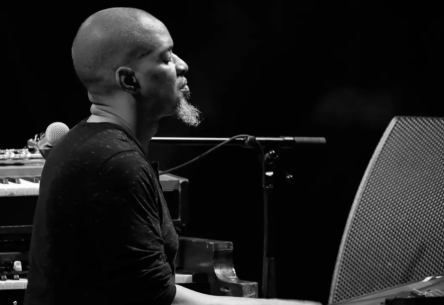
I can see him now, eyes closed, little tics of expression and appreciation flitting across his features, and I know exactly what he’d say if I were sitting beside him:

Listen…