A Writer Walks into a bar

(*A story written back in 2016)

In the dying light, evening shadows spilled like ink across the city streets as neon lights buzzed and flared with new life, and I finally arrived at the bar.

Millie was there, as always, her face tan, leathered, with deep lines sketched and stenciled by the tandem drawing of time and alcohol. She turned to look at me through eyes still somewhat beautiful, not quite bleary, but full of lost hope and unrequited love.

A local girl, she’d been feeding off the carrion of maudlin, weepy drunks for too long.

Getting out had been her dream. She’d been waiting, as they say, for her ship to come in, but someone told her to hold the anchor, and when she did, the ship left without her.

She squinted at me through a screen of patchy, blue-white smoke, slowly unfurling like spirits on drugs.

“Hey, Al.”

“Hey, Millie.”

“Book’s done?”

“Yeah.”

“Good for you.” She swiveled the stool to turn her whole self toward me.

“You need an agent?”

“I do. Know anyone?”

She shook her head. “Not anymore, sweetheart. Think you’re good enough?”

“I’m hoping.”

She tapped the cigarette ash into a gray-black ashtray and looked over my head. I followed her gaze to see a huge fly buzzing around a light bulb.

We watched it longer than was normal, until she finally looked at me again.

“I used to write.”

“I know, Millie.”

“I wasn’t good.”

“Not what I was told.” I ordered a beer.

She smiled, showing stained, chipped and missing teeth; if you weren’t used to seeing it, it was disconcerting at first. It never ceased to be heartbreaking, at least to me.

“You believe what you’re told?”

I straightened up on the barstool, seeking some sort of lumbar support that wasn’t there.

“You didn’t believe in yourself?”

Her eyebrows arched at that, and in a couple of heartbeats, her eyes welled.

She wiped the water away before it ruined her overdone mascara, but somehow she managed smudging it anyway.

“No, I didn’t.”

I waited a bit, letting her get back to herself.

She shifted on the stool, hooking an ankle around the circle on the bottom.

“Hard to get an agent these days, Al.”

“But not impossible.”

“No,” she shook her head slowly, and turned her left profile to me, “not impossible.”

We worked on the drinks, each of us sitting in separate silences of rising ambition and faded glory.

She finished her double, put out the cigarette, sidled off the stool, put her hand on my thigh to steady herself, and kissed me on the cheek.

Her lips were bourbon scented, her breath heavy with tobacco.

She patted me on the chest then stepped out of view behind me.

“Good night, Al.”

I watched her in the mirror as she opened the door and went out into the oncoming night.

I looked up at the light bulb.

The fly was gone.

“Good night, Millie.”

The Crofter of Words

The sun dips low, its gold fire now subdued to pleasing persimmon, and the the chiaroscuro of purples, pinks, and blues that quilt the twilight sky flare in a final flash of glory seen by the herald evening stars.

They form the night clusters that humanity marveled at, and pondered on, then feared, ascribing them power over the earth and the soul for ages untold.

And on this lonely, verdant hill, in this lonely, weary land, the breeze lacing through the branches hisses and warbles at the silence, incanting dirges of lost love and hard life among the stones and peat fires.

At night, the imprints of specters, felt more than seen, press against the walls of ether, retiring to their eternal beds of soil and decay, their farewells echoing down the halls of crumbling crypts, marbled with time, works, and fortune.

The names on the lids of their final possession fade in the dampness, becoming one with the surface again like a settling ripples.

And the crofters, the crafters of words, the farmers of feelings, caretakers of pruning the souls of unblessed believers in their words….they plant their poems and prose by night as well as day.

It is their hope that all the ragged, tattered universe, the deities that guide their thoughts and hands, see that it is good, and declare it.

Notebook Miscellany

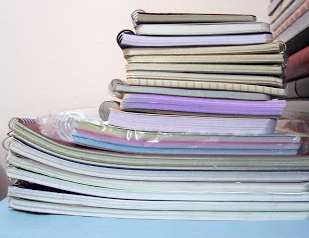
It’s a silly obsession with some of us who write, these gathered notebooks.

These bound things bind us to them in turn, using our words to link us to all of our thoughts, hold us to all of our promises, keep all of our secrets and confessions.

And yes, hide all of our pain.

Even though we may not use them all, it speaks of longing to fill them with something of ourselves that bears witness to our existence, and will speak of who we were to a world we’ll never see.

It’s the small sacrifice of a seemingly useless purchase that shows determination to leave something of value and beauty behind, born of something inside of us that we feel is worthy of legacy.

The empty notebooks perhaps tell the most noble of tales, bought as an act of defiance amid the onslaught of a world that speaks to us of random, earthly insignificance, an indifferent universe, and dead gods.

The empty, dusty notebooks you never fill are those that call the world a liar, for there is as much longing of the heart, profundity of thought, and depth of emotion on the blank page perhaps more than any other.

While there is yet time, you may impose the will of your intent on these blank pages, but if you never get the chance, or find your words unable to be shared in the end, they are no less a legacy to say something to the world, however joyous or painful.

Your work may be unfinished, Writer, but you are never incomplete.

The Writer and The Page

“Good morning, Page,” the Writer greeted the blank field of whiteness awaiting him.

“Ah, good morning, Writer. Come to challenge me again?”

The Writer smiled. “Not challenge, conquer.”

The Page returned the smile, though the Writer couldn’t see it. “A worthy, lofty goal.”

“It’s what writers do.”

“Oh? Tell me, Writer, is it worth the isolation, the distant look in the eyes of the person you’re talking to about what you’re writing, the alienation of family and friends, for the sake of justifying the most mundane of arts?”

“You think writing is mundane?”

“You don’t?”

“If I thought that, why would I do it?”

The Page smirked. “Because writers love to moan about their suffering. Dancers and painters alleviate their pain, or live with it, toting their equipment hither and yon. They don’t go on and on about it. They accept the pain as part of the price, but writers somehow always seem amazed by the cost of their craft.
“But the great ones, those artists who don’t write, embrace it. They are the ones who get remembered, the ones who last through the ages.
“Even musicians struggle with their demons, exorcising themselves through their instruments, but they’re on another level of suffering.”

The Writer found himself intrigued. “How so?”

The Page chuckled like a parent at a silly question from their child.

“When dancers have shows, they rehearse. When painters or sculptors have exhibits, they set about creating work that fill the spaces.
“Musicians? They daily spew their demons out into space, and those who hear and understand their gibbering respond to it. They’re taken along down whatever road  the music leads them, whether to perdition or redemption.

“Musicians are the eternal Pied Pipers of the times, destined to be followed even when they’d rather be alone.
“Only writers get to bemoan how real life plunders their ability to create. They say, ‘Oh well, no writing today then. I shall double my output tomorrow.’ And of course, they don’t.
“Every day they whine about their lives: children, spouses, and other family members who just don’t ‘get it.’ And my personal favorite: the pet who demands time and attention, or the kittens asleep on the keyboard.
“They act as if moving the animal is against the law! They let their creatures have their way over practicing their craft. It’s laughable.”
The Page laughed, and said when it was over, “My point is this: these are days writers don’t get back, but act as if somehow they will.”

“So what do you suggest?”

“Isn’t it obvious? Abandon this art, take up a trade and make yourself useful. Leave the writing to those already published. You are too undisciplined, lazy, and unfocused to make this work.”

“But my English teachers all said–”

“They were wrong. They deceived you.”

The Writer sat back, catching his breath, staring at the Page, who stared back, serene, but not smug, at least not outwardly so. The Writer honestly couldn’t figure out if it really believed what it said, or was just baiting him.

He suspected the latter, but he couldn’t let it go yet. “All of them?”

The Page stayed silent, content to let the seed of doubt sink in and hit home.

The Writer poured a shot of whiskey and took it with him, getting up to look out the window.

There were lives out there. Every one unique, going to destinations and fates unknown.
His book would be a droplet in the sea, in a world where there were better disciplined, laser focused, faster writers than himself.

Maybe his teachers were wrong. Had they smiled at him and lied? ‘That one may smile, and smile, and be a villain?’
His girlfriend said she always thought he should write, but did nothing to encourage it or support him. She read the occasional snippet, and praised it, but nothing more.

The whiskey burned his throat, and his flesh heated as the alcohol suffused into his bloodstream.

He held up the glass. How many of his kind had succumbed to this weakness. Or was it a weakness? Maybe not.Did the page back then, like this one, drive the writer to defeat as they drowned themselves and their talent, shot by shot?

He went to sit back down, staring again at the white silence before him, a white silence awaiting his words, subject to his imagination, unwilling to do his ready will.

The Page’s laughter was low, deep, reverberating as if they were together in a cave, and the Writer couldn’t see it standing in the shadows, drawing its knife.

Leave me, writer. I grow weary of your presence.

The Writer drained the glass, and put it back in his desk drawer.

Don’t you want another…?
The Writer didn’t answer, flexed his wrists and fingers over the keyboard.

You have nothing. You’re fooling yourself. It’s undignified, and beneath you. Stop it, ‘writer.’ Stop it, now.

The Writer sighed, and began to type: I am a Writer, and Page is my servant. A defiant, exasperating fool of a servant, but mine nonetheless…